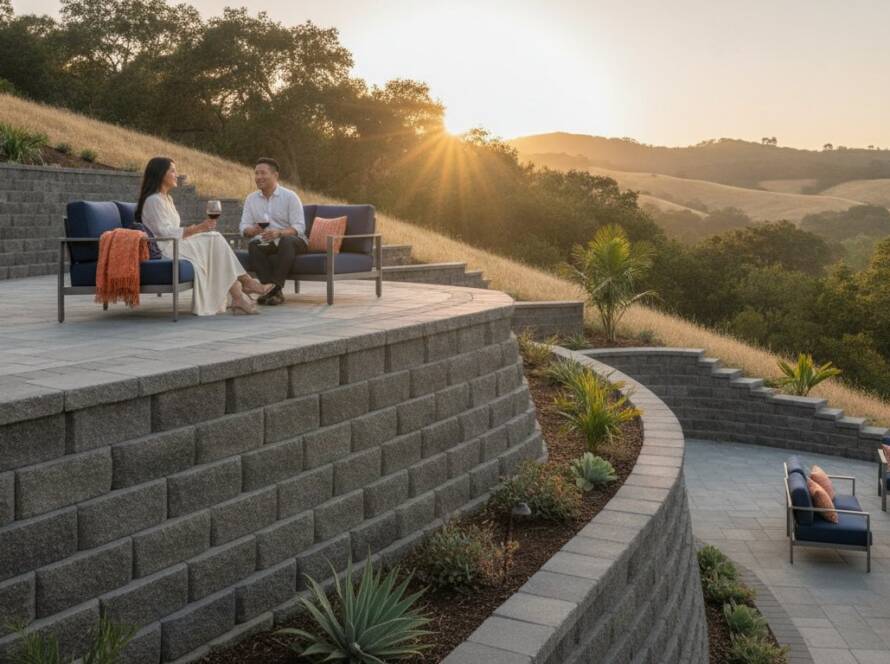
A poured concrete slab around your swimming pool is a ticking clock. In the East Bay, rigid concrete simply cannot withstand the subterranean reality of expansive clay soil, which swells aggressively with winter rains and shrinks during dry summers. The inevitable result is an uneven, cracked, and slick surface that compromises both your backyard safety and your home’s aesthetic. If you are researching pool deck pavers Orinda specialists recommend, you need a flexible segmental system designed to shift naturally without cracking, paired with engineered base preparation that manages hillside drainage.
You already know that living in the Orinda hills demands hardscaping built for real-world ground movement, not just showroom looks. You also know how frustrating it is to deal with unpredictable contractors, surprise change orders, and endless project delays. This guide breaks down exactly how to select, design, and install premium pool deck pavers engineered for our local microclimate and terrain. We will cover the best heat-reflective and slip-resistant materials, critical drainage requirements, and the construction standards necessary to ensure your pool deck remains stunning and stable for decades.
Key Takeaways
- Learn why flexible segmental pool deck pavers Orinda homeowners choose eliminate the cracking and shifting caused by local expansive clay soils.
- Compare the performance, slip resistance, and heat retention of concrete, outdoor porcelain, and natural stone around your pool.
- Discover the critical sub-base compaction and slope standards required to protect your home’s foundation from hillside runoff.
- Identify key contractor vetting criteria, including required California licensing, all-inclusive pricing, and comprehensive warranty coverage.
- See how single-source project management ensures seamless execution across coping, drainage, and integrated outdoor living features.
Why Pool Deck Pavers Outperform Poured Concrete in Orinda
Poured concrete works well in regions with stable subgrades, but Orinda is not one of them. Installing a continuous, rigid concrete slab over local ground guarantees eventual structural failure. Segmental interlocking systems solve this engineering challenge by replacing monolithic rigidity with intentional flexibility. Rather than fighting ground tension, a properly engineered surface composed of individual paving stone units moves harmoniously with subterranean pressures while preserving surface grade.
Factory-cured pavers deliver exceptional structural resilience, routinely achieving compressive strengths exceeding 8,000 PSI, compared to the roughly 3,000 to 4,000 PSI typical of standard poured-in-place slabs. Beyond sheer load capacity, segmental units eliminate the high repair costs associated with pool ownership. When underground plumbing lines, skimmers, or electrical conduits require inspection, technicians can lift specific stones without jackhammering the pool deck. Once repairs wrap up, workers reset the same units into the sand bed with zero visible patching.
Managing Orinda’s Expansive Soils and Hillside Shifting
The East Bay’s dense clay expands significantly as it absorbs heavy winter rainfall, then contracts as summer drought drains subsurface moisture. Because a poured slab cannot flex, it fractures along stress points, leaving behind jagged cracks that widen every season. In contrast, selecting interlocking pool deck pavers Orinda properties require ensures that structural tension distributes evenly across flexible joint sand. The system accommodates subtle subgrade shifts seamlessly, preventing visible fractures and protecting the pool’s structural bond beam from lateral drag.
Safety First: Heat Dissipation and Wet-Foot Traction
Safety around an active swimming pool depends entirely on texture and thermal performance. Smooth, sealed concrete slabs often become slick hazards as soon as swimmers splash water onto the surface. Premium interlocking systems utilize specialized micro-textures designed to maintain high wet-traction ratings. In addition, chamfered edge profiles guide runoff away from pedestrian corridors into engineered drainage paths. When building with light-toned concrete or outdoor porcelain, the decking reflects intense summer sunlight, keeping pool perimeters comfortably cool under bare feet even during high-heat July afternoons.
Top Materials for Orinda Pool Decks: Concrete vs. Porcelain vs. Natural Stone
Material selection defines your pool deck’s daily comfort, long-term durability, and maintenance overhead. In Orinda, harsh summer sun, hillside native oaks, and expansive clay require materials that resist chemical etching, thermal buildup, and shifting grades. Industry research confirms that segmental paving units reliably outperform poured concrete under these environmental stressors. Choosing the right product ensures that your outdoor investment holds its structural integrity without fading or degrading around chlorinated or saltwater systems.
Interlocking Concrete Pavers: Durability and Design Versatility
Concrete pavers remain the standard for residential hardscapes. Reputable regional manufacturers like Calstone engineer these units with through-body color blending, protecting the surface against ultraviolet bleaching during hot California summers. Their textured faces provide dependable wet traction, while chamfered profiles ensure rapid drainage during unexpected storms. To see how these elements combine into an cohesive layout, review our hardscape design and installation guide.
Architectural Porcelain Pavers: Contemporary Style and Zero Porosity
Outdoor porcelain has quickly become a premier choice for modern hillside homes. Fired at kiln temperatures exceeding 2,200 degrees Fahrenheit, porcelain achieves a certified water absorption rate below 0.5 percent, compared to 5 to 8 percent for standard concrete. This density makes porcelain impervious to salt chlorination etching, algae accumulation, and fallen oak tannin stains. On a 95-degree afternoon, light-toned porcelain stays 25 to 35 degrees cooler under bare feet than darker paving surfaces. Check our porcelain paver installation bay area guide to understand the strict base requirements needed for these zero-tolerance systems.
Travertine and Natural Stone: Classic Luxury Considerations
Quarried stone delivers timeless beauty, but it requires careful vetting for East Bay properties:
- Travertine: Light ivory and beige varieties naturally dissipate solar heat, remaining cool under intense sun. Choose tumbled finishes to maximize wet-foot traction around perimeter edges.
- Porosity controls: Natural stone readily absorbs saltwater and organic debris. It demands penetrating sealers to prevent pitting, subsurface mineral crystallization, and winter freeze-thaw spalling.
- Bedding requirements: Flagstone and irregular slates require mortared or specialized aggregate bedding to resist root intrusion and ground heaving.
Selecting the ideal material requires balancing aesthetic preference against maintenance commitments. If you are comparing materials for your property, consulting with Bayside Pavers can clarify which surface matches your specific hillside terrain and everyday pool use.
Critical Engineering: Sub-Base, Drainage, and Coping Integration
Surface pavers provide the visual appeal, but the underground foundation determines whether your hardscape survives East Bay winters. In fact, sub-base preparation accounts for roughly 60% of all installation labor. Without precise excavation, mechanical compaction, and intentional water routing, even the highest-grade paving stones will settle unevenly. For homeowners investing in premium pool deck pavers Orinda contractors must design structural systems that decouple deck movement from the swimming pool shell while controlling intense hillside hydraulic pressure.
Excavation, Geotextile Fabric, and Crushed Aggregate Compaction
Every long-lasting installation begins by stripping away weak topsoil down to solid subgrade clay. Crews line this excavated trench with heavy-duty woven geotextile fabric. This critical separation layer prevents the crushed aggregate base from migrating down into wet clay over time. Next, installers place Class II aggregate base in thin lifts, mechanically compacting each pass to eliminate microscopic air pockets. A laser-leveled one-inch layer of coarse bedding sand sits directly atop the compacted rock, establishing a flat, uniform bed for setting pavers.
Managing Surface Runoff on Sloped Orinda Properties
Hillside lots require rigorous surface and sub-surface water management. California Building Code mandates that pool decks maintain a surface slope between 1% (1/8-inch per foot) and 2% (1/4-inch per foot) pitching directly away from the coping. This gradient directs surface splash and storm runoff toward dedicated low-profile channel drains set flush with the paver plane. These systems tie directly into closed storm lines or designated discharge zones to prevent erosion, mirroring guidelines from the EPA on permeable pavement that emphasize controlled drainage capture.
| Engineering Component | Standard Specification | Hillside Protection Role |
|---|---|---|
| Geotextile Membrane | Woven polypropylene fabric | Separates sub-base aggregate from expansive native clay |
| Base Aggregate | Compacted Class II crushed stone | Distributes surface loads and prevents localized settling |
| Deck Slope | 1% to 2% away from pool lip | Prevents chlorinated splash-out from pooling behind the bond beam |
| Isolation Joint | Closed-cell foam with elastomeric seal | Absorbs deck shifts without transferring lateral stress to the pool coping |
Pool Coping Transitions: Bullnose vs. Modern Cantilevered Edges
The coping unit transitions your vertical pool wall to the horizontal patio surface. Rounded bullnose edges offer a traditional look and a comfortable grip for swimmers climbing out of the water. In contrast, square-edge cantilevered stones provide the clean, rectilinear profile favored in modern architectural layouts. Regardless of style, coping units must mortar directly to the structural pool bond beam. A flexible elastomeric expansion joint separates the secured coping from the field pavers, ensuring ground settlement never shears the pool’s structural lip.

How to Choose an Orinda Paver Contractor: Vetting and Red Flags
Hiring the right installer matters just as much as picking the right stone. A poorly executed installation turns high-end materials into an uneven, hazardous mess within a few rainy seasons. When vetting teams to install pool deck pavers Orinda homeowners should treat the hiring process like an engineering audit. You need a contractor who understands the complexities of Contra Costa County building requirements, hillside stabilization, and precise subgrade drainage.
Essential Credentials, California Licensing, and Insurance
Never hire an unverified crew. Check the California Contractors State License Board (CSLB) database to confirm your contractor maintains an active Class A (General Engineering), Class B (General Building), or C-27 (Landscaping) license with clear workers’ compensation coverage. Direct factory certifications from proven manufacturers like Calstone demonstrate verified mastery of proper aggregate depths and joint stabilization. Reputable contractors also navigate local building codes confidently, pulling necessary permits when deck elevations, retaining elements, or surface drainage changes require city oversight.
Transparency in Pricing and Avoiding Mid-Build Change Orders
Low bids are often expensive traps. Disreputable contractors submit artificially low initial quotes, only to issue costly change orders the moment excavation begins. Protect your investment by requiring an itemized, all-inclusive proposal. Your contract should detail every phase: site access plans, excavation depths, aggregate types, drainage tie-ins, coping mortars, and complete debris removal. For an exhaustive walkthrough on project scope and logistics, review our pool deck installation bay area resource.
- Clear Scope: Look for defined aggregate base depths rather than vague prep promises.
- Fixed Pricing: Insist on a single, binding price that eliminates mid-build surprises.
- Sub-Surface Terms: Ensure the agreement explicitly outlines soil management protocols upfront.
Project Timeline Guarantees and Daily Construction Momentum
Home improvement should not drag on indefinitely. Abandoned job sites, inconsistent sub-contractors, and disappearing crews cause unnecessary stress. Quality builders deploy consistent daily crews and complete standard residential pool decks within an average three-week timeframe. Above all, require a dedicated on-site project manager who acts as your single point of contact, ensuring continuous quality control and immediate communication from initial layout to final joint sanding. A builder confident in their engineering will also back their work with a comprehensive 25-year installation warranty.
Ready to build a deck designed for hillside stability? Schedule a design consultation with Bayside Pavers to secure fixed pricing and dedicated project leadership for your property.
Transform Your Backyard: The Bayside Pavers Advantage in Orinda
Home improvement projects should inspire confidence, not anxiety. When upgrading your outdoor living space with premium pool deck pavers Orinda properties require, execution matters just as much as engineering. Bayside Pavers removes the common frustrations of construction by deploying an organized, repeatable management system. We eliminate surprise change orders, communicate daily, and hold ourselves strictly accountable to planned schedules and structural excellence.
Our operational model centers on certainty. Every project receives dedicated on-site project management, ensuring that a single accountable expert supervises subgrade compaction, drainage alignments, and paver cuts every day. Crews arrive on site consistently, completing residential pool deck installations within an average three-week timeframe. Backing our structural craftsmanship is an ironclad 25-year warranty on workmanship, giving you permanent peace of mind that your investment will withstand the East Bay’s seasonal ground movement.
Our 3-Step Stress-Free Installation Process
A proven build begins with disciplined preparation. Our streamlined sequence delivers consistent outcomes without typical contractor friction:
- Step 1: Consultation and Evaluation: We conduct an in-depth on-site evaluation to analyze your yard’s slope, native clay conditions, existing drainage channels, and aesthetic goals while setting a clear budget expectation.
- Step 2: Material and Design Review: During a personalized design consultation, our team brings physical concrete, porcelain, and stone samples directly to your residence to match textures, coping profiles, and colors against your architecture.
- Step 3: Precision Construction: Permanent in-house crews execute excavation, aggregate base stabilization, and paver laying under daily supervision, delivering completed projects within an average three-week window.
Seamless Integration with Complete Outdoor Living Spaces
A swimming pool rarely exists in isolation. Maximizing your property requires unifying surrounding elevation changes and entertaining zones into a cohesive master design. We integrate pool perimeters with engineered retaining walls designed to hold back uphill grades and prevent seasonal silt runoff from reaching the deck surface. For low-maintenance entertaining areas, property owners frequently pair paved perimeters with high-drainage synthetic turf; explore material options in our synthetic turf installation guide.
From custom outdoor kitchens and gas fire pits to shaded pergolas, our team handles all structural components under single-source accountability. Ready to turn your backyard into a durable, beautifully engineered retreat? Schedule your free design consultation with Bayside Pavers today to get an upfront, all-inclusive proposal tailored to your property.
Build a Stable, Beautiful Pool Surround for Decades to Come
Living in the East Bay hills offers incredible scenic living, but it also demands hardscapes engineered for real ground movement. Choosing the right pool deck pavers Orinda installation requires looking past surface aesthetics. Long-term performance depends on flexible segmental layouts, proper base excavation, and strict drainage management designed to keep water away from your home’s foundation.
You do not have to accept cracked concrete or contractor delays. Bayside Pavers provides a clear path forward with dedicated on-site project management, structured builds completed in about three weeks, and all-inclusive upfront pricing with zero hidden change orders. We take complete ownership of every phase, backing our structural craftsmanship with an industry-leading 25-Year Workmanship Warranty.
Take the first step toward an elevated backyard retreat today. Schedule your free Orinda design consultation with our team, and let us build an outdoor living space your family will enjoy for generations.
Frequently Asked Questions
Can you install pool deck pavers directly over an existing concrete deck in Orinda?
Overlaying pavers onto cracked concrete is generally not recommended in Orinda. Local clay soil expansion causes existing slabs to heave, which directly transfers cracks and uneven settlement up into the new paver surface. Additionally, adding pavers on top of concrete elevates the finished grade, interfering with pool coping transitions and doorway clearances. Full demolition and excavation down to a stable subgrade ensure proper compaction and drainage.
Are interlocking pavers slippery when wet compared to traditional stamped concrete?
No, interlocking pavers offer superior wet-foot traction compared to stamped or smooth concrete. Stamped concrete requires topical acrylic sealers that form an impermeable, slick film when wet. In contrast, textured concrete pavers and anti-slip outdoor porcelain maintain high friction coefficients. Surface water quickly channels away through chamfered joints rather than creating standing puddles along active walking corridors.
How do pool deck pavers hold up against saltwater pool chlorination systems?
Porcelain pavers and properly sealed concrete pavers resist saltwater exposure exceptionally well. Fired porcelain has a water absorption rate under 0.5%, meaning salt solutions cannot penetrate the tile to cause pitting or efflorescence. Standard concrete units around saltwater pools require a high-quality penetrating silane-siloxane sealer to block chloride ions from degrading the cement matrix over time.
What happens if underground pool plumbing leaks beneath an interlocking paver deck?
Interlocking systems make underground plumbing repairs straightforward and cost-effective. Technicians mark the leak location, extract individual paving stones, and set them aside without using heavy demolition equipment. Once the plumbing crew completes pipe repairs and re-compacts the bedding aggregate, the original pavers are reinstalled seamlessly. There are no mismatched concrete patches or permanent structural scars left on your deck.
How do you keep weeds and ants from invading joints between pool pavers?
Weed and insect intrusion is prevented by using high-performance polymeric joint sand rather than ordinary masonry sand. Polymeric sand contains chemical binders that harden into an elastic, erosion-resistant barrier upon water activation. This firm barrier blocks airborne seeds from germinating and stops ants from tunneling through the joints, while maintaining the flexibility needed to handle subtle ground shifts.
How long does a professional pool deck paver installation take in Orinda?
A professional installation of pool deck pavers Orinda homeowners schedule typically takes about three weeks to complete. Bayside Pavers maintains momentum with consistent, dedicated daily crews and an on-site project manager overseeing every phase. This timeline covers demolition of existing hardscape, mechanical base compaction, drainage trenching, coping installation, and precision paver placement through final joint sanding.

Article by
Adriana Esposito
Adriana Esposito is the owner of Bayside Pavers, a woman-owned outdoor living company serving the San Francisco Bay Area. With over 16 years of experience, she specializes in designing and building custom paver patios, driveways, outdoor kitchens, retaining walls, artificial turf, and other outdoor living spaces. Through this blog, she shares expert tips, design inspiration, and practical advice to help homeowners create beautiful, lasting outdoor spaces.