The most expensive paver project you can buy in the San Francisco Bay Area is the one you have to install twice. While many homeowners start their journey looking for the lowest paver patio cost bay area, the reality is that surface beauty means nothing without sub-surface integrity. You’ve probably already encountered the frustration of inconsistent quotes and the nagging fear that site preparation is just a code word for hidden fees. It’s exhausting to navigate a market where prices seem to shift depending on which contractor walks through your gate.
We believe you deserve a transparent, predictable path to a better backyard. This guide provides a clear breakdown of the engineering variables, material tiers, and logistical hurdles that define local pricing in 2026. You’ll gain the confidence to look past the initial numbers and understand the true drivers of long-term value. We’ll explore how fixed pricing models and rigorous soil preparation prevent project failure; this ensures your new outdoor space remains a durable asset that significantly increases your home’s market appeal.
Key Takeaways
- Learn why material-only prices are misleading and how to budget for a comprehensive installation that includes labor, excavation, and project management.
- Understand how logistical factors like site accessibility and project size determine your total paver patio cost bay area more than the choice of stone.
- Identify the critical invisible engineering requirements, such as a 4-6 inch compacted base and professional drainage, that prevent future surface failure.
- Discover how to compare material options like concrete and natural stone to find the right balance between upfront installation costs and long-term durability.
- Eliminate the risk of hidden fees by prioritizing contractors who offer fixed, all-inclusive pricing and substantial long-term warranties.
The Components of Paver Installation Pricing in the Bay Area
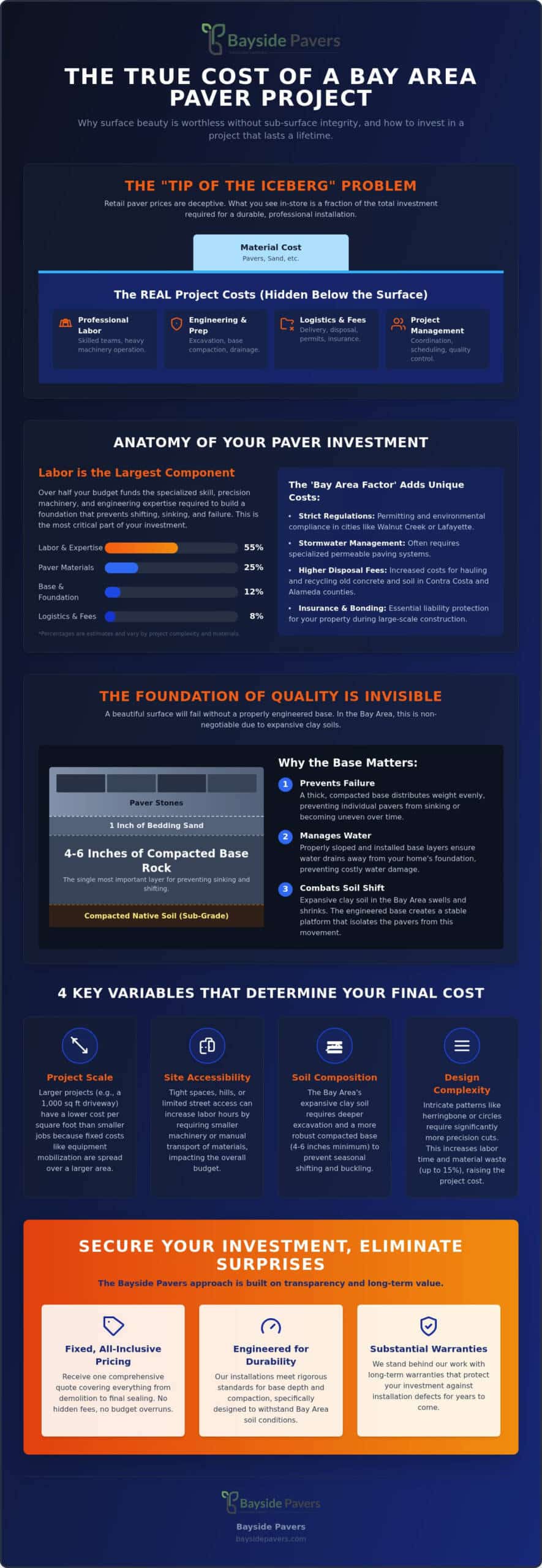
Many homeowners browse big-box stores and see pavers priced at a few dollars per square foot. This creates a false baseline for the total paver patio cost bay area. Those prices reflect the raw material only; they don’t account for the logistical reality of getting them to your yard or the engineering required to keep them level for decades. Relying on retail prices leads to significant budget overruns once the actual work begins.
All-inclusive hardscape pricing is a model that covers everything from demolition to the final seal. This approach eliminates the “nickel and diming” that often plagues the construction industry. Instead of managing separate line items for gravel, sand, delivery fees, and fuel surcharges, you receive a single, transparent figure. This level of accountability ensures the project manager owns every variable from the first shovel in the ground to the final inspection.
Material Costs vs. Installation Labor
Professional labor often accounts for over 50% of your total investment. This isn’t just for manual effort. It covers the specialized skill of operating heavy machinery like mini-excavators and high-impact plate compactors. In 2026, local supply chain logistics continue to impact the availability of specific stones and bedding gravel. A professional installation team doesn’t just lay stones; they engineer a multi-layered system designed to withstand soil movement and heavy foot traffic. We manage these schedules to prevent the types of delays that often stall smaller, uncoordinated crews.
The ‘Bay Area Factor’: Local Economic Drivers
Operating in Northern California introduces unique cost drivers that national averages ignore. Environmental regulations and strict permitting processes in cities like Walnut Creek or Lafayette require precise documentation. Managing stormwater runoff often involves integrating permeable paving systems to comply with local codes. These requirements influence the final paver patio cost bay area by dictating the depth of excavation and the specific type of base materials used.
Disposal fees are another significant factor. In counties like Contra Costa and Alameda, the cost to haul away and recycle old concrete or excavated soil has risen steadily. Licensed and bonded contractors also carry higher insurance premiums to protect your property during construction. While these overhead costs might seem invisible, they provide the security and legal protection necessary for a large-scale home improvement project. Choosing a local expert means you’re investing in a partner who understands these regional nuances and includes them in the upfront quote.
Primary Variables Determining Your Cost Per Square Foot
Calculating a flat rate for a project is impossible without evaluating the specific physical constraints of your property. While materials have a set price, the labor required to install them fluctuates based on efficiency. For example, a 1,000-square-foot driveway often has a lower price per square foot than a 200-square-foot walkway. This is because mobilization costs, like transporting heavy machinery and setting up the site, are spread across a larger area. Smaller projects still require the same equipment and planning but offer fewer square feet to absorb those fixed overheads.
Soil composition is another major driver of the paver patio cost bay area. Much of the region sits on expansive clay, which shifts significantly during the wet and dry seasons. To prevent your investment from buckling, we must excavate deeper and install a more robust base of compacted gravel. In some cases, homeowners choose Permeable Pavement systems to manage local drainage requirements, which involves specialized aggregates and specific engineering standards. If you’re unsure how your ground conditions will impact the budget, calculating your unique site requirements with an expert is the first step toward a fixed quote.
Pattern Complexity and Cutting
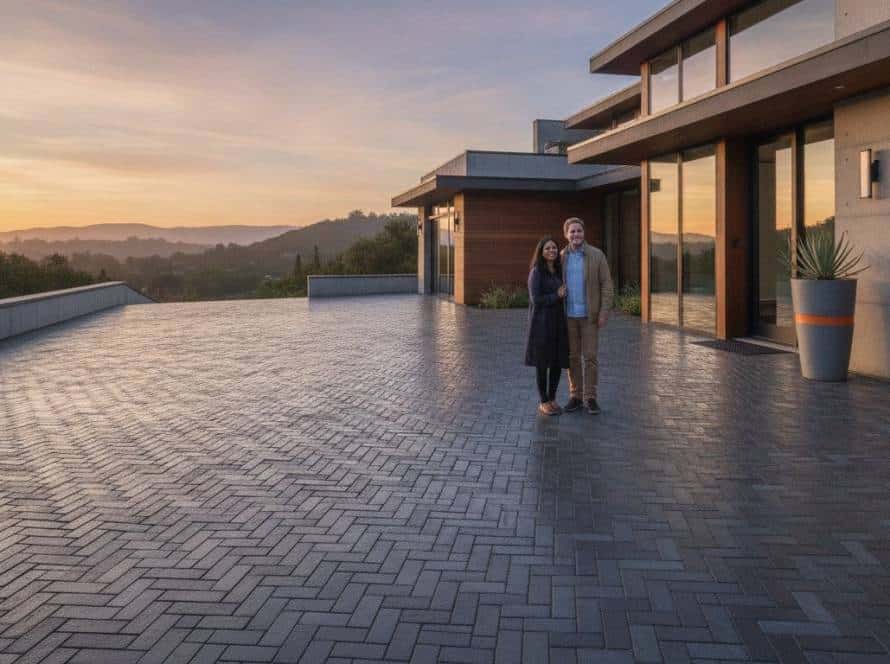
The design you choose directly impacts the total labor hours. A simple running bond pattern requires minimal cuts, whereas a herringbone or circular design demands precision at every edge. These intricate layouts increase the waste factor to 10-15% because more stones are cut into unusable shapes. We also account for soldier courses, which are the decorative borders that frame the patio. These features add structural stability and aesthetic polish but require additional time to align and set correctly. Complex patterns don’t just use more stone; they require a higher level of craftsmanship to ensure the lines remain straight across the entire surface.
Site Conditions and Prep Requirements
Preparation is the most labor-intensive phase of any build. If your project involves removing old asphalt or four-inch-thick concrete, demolition costs will typically range from $5 to $10 per square foot. Site accessibility also dictates the equipment we can use. If a backyard has a narrow side gate, we may have to use smaller machinery or resort to hand-digging, which increases the labor budget. Finally, managing slopes is critical. Grading a hillside lot to ensure water flows away from your foundation can add $5,000 to $15,000 in engineering and drainage costs, depending on the severity of the incline and the need for retaining structures.
Material Selection: Balancing Aesthetics with Installation Expense
Your choice of material acts as the primary aesthetic driver, but it also dictates the complexity of the installation process. In the San Francisco market, concrete pavers remain the standard for durability and versatility. They are engineered to meet strict industry installation standards, providing a uniform thickness that allows for faster, more predictable labor timelines. For high-traffic areas like driveways, these interlocking systems provide the structural integrity needed to support vehicle weight without the cracking common in poured concrete.
Natural stone and brick offer a timeless appeal but require a more significant labor investment. Because these materials often vary in thickness and dimensions, our crews must spend more time hand-leveling each piece to ensure a flush surface. This precision work directly impacts the total paver patio cost bay area. While the raw material cost is higher, the primary expense stems from the craftsmanship required to fit irregular shapes into a cohesive, safe walking surface. We manage this trade-off by providing clear expectations on how specific stone choices will extend the project timeline.
Durability and Maintenance Trade-offs
Investing in a paver system offers a superior return on investment compared to traditional surfaces. A professionally installed patio in the Bay Area can yield a 60% to 80% return at resale, largely because pavers don’t suffer from the seismic cracking that plagues monolithic concrete slabs. Porcelain requires only a basic rinse to maintain its appearance, whereas natural stone needs periodic sealing to protect against moisture and staining. Choosing a material with a 25-year warranty ensures your outdoor space remains an asset rather than a maintenance burden.
Specialty Options: Permeable and Porcelain
High-performance materials like porcelain and permeable units solve specific environmental challenges. Permeable systems are a strategic choice for North Bay properties dealing with heavy seasonal rainfall; they allow water to filter directly into the ground, reducing the load on municipal storm drains. For modern pool decks, we often recommend porcelain. This material is non-porous, slip-resistant, and stays cool under the California sun. However, the technical requirements for porcelain paver installation bay area are rigorous. It requires a specialized thin-set or sand-set method that only experienced teams can execute correctly. While these premium options increase the initial paver patio cost bay area, they eliminate long-term issues like salt damage or drainage failure.
The ‘Invisible’ Costs: Engineering the Foundation and Drainage
The longevity of your outdoor space depends entirely on what lies beneath the surface. While the stones provide the visual appeal, the engineering determines if that beauty lasts five years or fifty. Before any excavation begins, utility locating is a mandatory safety step. Identifying gas, water, and electrical lines protects your property and prevents costly emergency repairs. Once the site is clear, we install high-quality geotextile fabrics. This low-cost addition creates a critical separation layer between the native soil and your new base. It prevents shifting over time and acts as a primary defense against weed growth from the ground up.
These preparation steps are often where quotes vary wildly. A lower paver patio cost bay area often indicates a contractor is cutting corners on the sub-surface work. We prioritize these “invisible” components because they are the only way to ensure a stable, level surface that withstands the region’s unique environmental pressures.
Why the Foundation Dictates the Price
A professional installation requires a non-negotiable sub-base of 4 to 6 inches of compacted gravel. This foundation is the primary driver of our 25-year warranty. Without sufficient depth and mechanical compaction, the ground will eventually settle; this causes the pavers to dip and creates trip hazards. We use specialized plate compactors to achieve maximum density. Following the base, we apply a precise layer of bedding sand. This specific aggregate provides the interlocking stability necessary to keep the units from moving laterally under foot traffic or vehicle weight. Proper foundation work is labor-intensive, but it prevents the catastrophic failure of your investment.
Water Management and Drainage
Drainage failure is the leading cause of hardscape damage. In the Bay Area, seasonal downpours can quickly undermine a poorly planned patio. We utilize laser grading to ensure a consistent slope that directs water away from your home’s foundation. For properties with elevation challenges, we frequently coordinate the build with a retaining wall installation bay area. This structural integration prevents soil erosion and creates level usable space on sloped lots.
Integrating French drains or surface grates into the initial quote is a standard practice for high-performance builds. These systems manage runoff and protect the integrity of the sub-base. While these engineering requirements increase the initial paver patio cost bay area, they eliminate the need for expensive drainage corrections in the future. To understand the specific engineering requirements for your property, schedule a professional site assessment to receive a fixed, all-inclusive project plan.
Securing Value: Fixed Pricing and the Bayside Advantage
The most common complaint in the Bay Area construction market isn’t the initial quote; it’s the final bill. Many homeowners start a project only to find that “unforeseen” site conditions or logistical hurdles lead to a series of expensive change orders. This volatility makes it impossible to accurately predict your total paver patio cost bay area. We’ve eliminated this anxiety by moving away from the traditional “estimate” model in favor of a fixed, all-inclusive pricing structure. The price we agree upon after your consultation is the price you pay. There are no hidden fees for equipment mobilization, site cleanup, or project management.
Our 3-week completion guarantee serves as a critical component of this value proposition. We understand that a construction project disrupts your daily routine and limits the use of your property. By deploying a dedicated project manager to every build, we maintain a rigorous schedule that prioritizes efficiency without sacrificing craftsmanship. This managed approach ensures that your investment starts generating value immediately rather than languishing as a half-finished construction site. You’re not just paying for stones and labor; you’re paying for a controlled, repeatable system for success.
The Value of a Fixed-Price Contract
Bayside Pavers avoids the change order trap through a thorough three-step process: Consultation, Fixed Pricing, and Project Management. We conduct a deep analysis of your property’s soil, accessibility, and drainage needs before we present a number. This transparency provides peace of mind because you’ll know the final cost before a single stone is moved. We take full ownership of the project lifecycle, acting as both the skilled artisan and the rigorous coordinator. This eliminates the need for you to manage multiple subcontractors or worry about shifting timelines.
Long-Term ROI and the 25-Year Warranty
When you evaluate the paver patio cost bay area, it’s essential to look at the cost per year of service. A budget installation without a warranty might save money upfront, but it often requires expensive repairs within five years due to settling or poor drainage. Our 25-year warranty on installations shifts the financial risk away from the homeowner. This long-term protection, combined with the fact that professional paver installation bay area significantly increases property appraisal values, makes a high-quality build the most fiscally responsible choice. To begin your project with a partner who values your time and financial commitment, Schedule your free design consultation today.
Building Your Future Outdoor Space with Certainty
Investing in your home’s exterior shouldn’t feel like a gamble. While the initial paver patio cost bay area is influenced by material choice and site accessibility, the true value lies in the engineering you can’t see. A deep, compacted foundation and integrated water management systems are the only ways to protect your hardscape from the region’s shifting soils. We’ve refined a three-step system that eliminates the typical stress of home improvement. By providing a fixed-price guarantee, we ensure you never face mid-project surprises or hidden fees.
Our commitment to your investment includes a 25-year installation warranty and a 3-week project completion timeline. You deserve a partner who takes full ownership of the process, from the first design consultation to the final walkthrough. Stop guessing about your budget and start planning for a durable, high-value outdoor living area. Get Your Free, All-Inclusive Paver Estimate and take the first step toward a backyard that stands the test of time. We look forward to helping you transform your property into a permanent, high-performance asset.
Frequently Asked Questions
Is a paver patio cheaper than a poured concrete patio?
Pavers typically require a higher initial investment than basic poured concrete due to the labor-intensive excavation and base preparation. However, they offer superior long-term value. Poured concrete often cracks under the Bay Area’s seismic activity and soil movement; these repairs are expensive and unsightly. Pavers are individual units that flex with the ground. You won’t face the high cost of a total replacement if a single area shifts.
How much does a 20×20 paver patio cost in the Bay Area?
The total paver patio cost bay area for a 400-square-foot space depends on your material choice and site accessibility. In 2026, professional installation for a standard project of this size typically ranges from $8,000 to $14,000. This figure includes excavation, a compacted gravel base, and high-quality concrete units. If your yard requires significant grading or the removal of old concrete, these engineering costs will increase the final budget.
Do I need a permit for paver installation in Walnut Creek or Concord?
Permitting requirements vary by city and the scope of your project. In Walnut Creek and Concord, small patios often don’t require a permit if they remain below a certain square footage and don’t alter drainage patterns. However, larger projects or those involving retaining walls almost always require municipal approval. We handle the permit application process as part of our project management to ensure your build complies with all local regulations.
How long do pavers last compared to asphalt or concrete?
Professionally installed pavers can last 25 to 50 years with minimal maintenance. This significantly outperforms asphalt, which usually requires resurfacing every 10 years, and poured concrete, which often develops structural cracks within 15 years. Because pavers are high-density units, they resist the freeze-thaw cycles and root pressure better than monolithic slabs. Our 25-year warranty reflects our confidence in the durability of the engineered systems we build for local homeowners.
Does the price per square foot include the removal of my old driveway?
Standard quotes for the paver patio cost bay area usually focus on the installation of the new system. Demolition and hauling of existing asphalt or concrete are typically calculated as separate line items in a fixed-price contract. In 2026, disposal fees in counties like Alameda and Contra Costa have risen; this makes the removal phase a significant part of the budget. We provide an all-inclusive quote that clearly details these costs.
Will a new paver driveway increase my home value?
A professionally installed paver driveway or patio is a high-yield investment. Real estate data for the San Francisco Bay Area indicates that high-quality hardscaping can return 60% to 80% of its cost at the time of resale. Potential buyers view pavers as a premium, low-maintenance feature that enhances curb appeal. Beyond the financial return, it expands your usable living space; this is a major selling point in our competitive local market.
What happens if the pavers shift or sink after installation?
Shifting or sinking is almost always the result of poor base preparation or inadequate compaction. If this occurs, the advantage of a paver system is that individual units can be removed, the base can be releveled, and the same pavers can be reinstalled. This is a simple, cost-effective fix compared to patching cracked concrete. Our installations are protected by a 25-year warranty, which covers structural integrity and prevents these issues from becoming your burden.
Can I save money by purchasing the pavers myself?
Purchasing materials yourself rarely results in significant savings and often complicates project logistics. Professional contractors receive wholesale pricing that isn’t available to the general public. Additionally, we take full responsibility for the quantities, delivery schedules, and material quality. If you buy the stone yourself, you’re responsible for breakages, shortages, and coordinating delivery with the installation crew. Our all-inclusive model simplifies the process and ensures we own every variable.

Article by
Adriana Esposito
Adriana Esposito is the owner of Bayside Pavers, a woman-owned outdoor living company serving the San Francisco Bay Area. With over 16 years of experience, she specializes in designing and building custom paver patios, driveways, outdoor kitchens, retaining walls, artificial turf, and other outdoor living spaces. Through this blog, she shares expert tips, design inspiration, and practical advice to help homeowners create beautiful, lasting outdoor spaces.